
TWO:
THREE:[Pg 255]Closely connected with the materialism of the Stoics, and equally adverse to the principles of Plato and Aristotle, was their fatalism. In opposition to this, Plotinus proceeds to develop the spiritualistic doctrine of free-will.438 In the previous discussion, we had to notice how closely his arguments resemble those employed by more modern controversialists. We have here to point out no less wide a difference between the two. Instead of presenting free-will as a fact of consciousness which is itself irreconcilable with the dependence of mental on material changes, our philosopher, conversely, infers that the soul must be free both from the conditions of mechanical causation and from the general interdependence of natural forces, because it is an individual substance.439 In truth, the phenomena of volition were handled by the ancient philosophers with a vagueness and a feebleness offering the most singular contrast to their powerful and discriminating grasp of other psychological problems. Of necessarianism, in the modern sense, they had no idea. Aristotle failed to see that, quite apart from external restraints, our choice may conceivably be determined with the utmost rigour by an internal motive; nor could he understand that the circumstances which make a man responsible for his actions do not amount to a release of his conduct from the law of universal causation. In this respect, Plato saw somewhat deeper than his disciple, but created298 fresh confusion by identifying freedom with the supremacy of reason over irrational desire.440 Plotinus generally adopts the Platonist point of view. According to this, the soul is free when she is extricated from the bonds of matter, and determined solely by the conditions of her spiritual existence. Thus virtue is not so much free as identical with freedom; while, contrariwise, vice means enslavement to the affections of the body, and therefore comes under the domain of material causation.441 Yet, again, in criticising the fatalistic theories which represent human actions as entirely predetermined by divine providence, he protests against the ascription of so much that is evil to so good a source, and insists that at least the bad actions of men are due to their own free choice.442
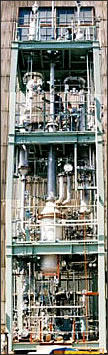
High quality is being demanded in many fields nowadays and so in order to satisfy that we developed a high-purity distillation system in collaboration with Ube industries, Ltd. and Kanto Chemical Co., Inc. The system is used to refine cleaning solutions for the semiconductor industry, medical materials, etc. of high purity (residual ion concentration: 0.01 to 1.0 ppb).
- Our High-purity distillation system provide our clients with high solvent recovery rate, almost 100%.
- The quality of the products/output from our system is very stable, which makes production management very easy, and easier than the conventional ion exchange resin method.
- No emission of waste brings our clients reduction of running cost for environmental measures.
- Our various devices minimize entrainment.
- To prevent the elution of metal, you could ask us the system made of Teflon.
- Our High-purity distillation system has been already proved for solvents that trigger very rapid decomposition reactions, such as hydrogen peroxide.
- Product guide
- Alcohol distillation
- Distillation equipment
- High-purity distillation system
- Membrane separation type solvent dehydration system
- Reactor
- Evaporative concentration equipment
- Coulter spray dryer
- Microwave treatment system
- Filter dryer
- OS filter (continuous vacuum rotating filter)
- Hydrocyclone (liquid cyclone)
- Thermal oil heater (heat medium boiler)
- Process air heater (air heater)
- Ammonia treatment system
- Catalytic deodorizing equipment for ammonia and VOC gas
- Stationary cryogenic storage tank
- Portable cryogenic container
- Cryogenic liquefied gas evaporator